
Cloud DevOps Consulting: A Strategic Framework for Enterprise Modernization in 2026
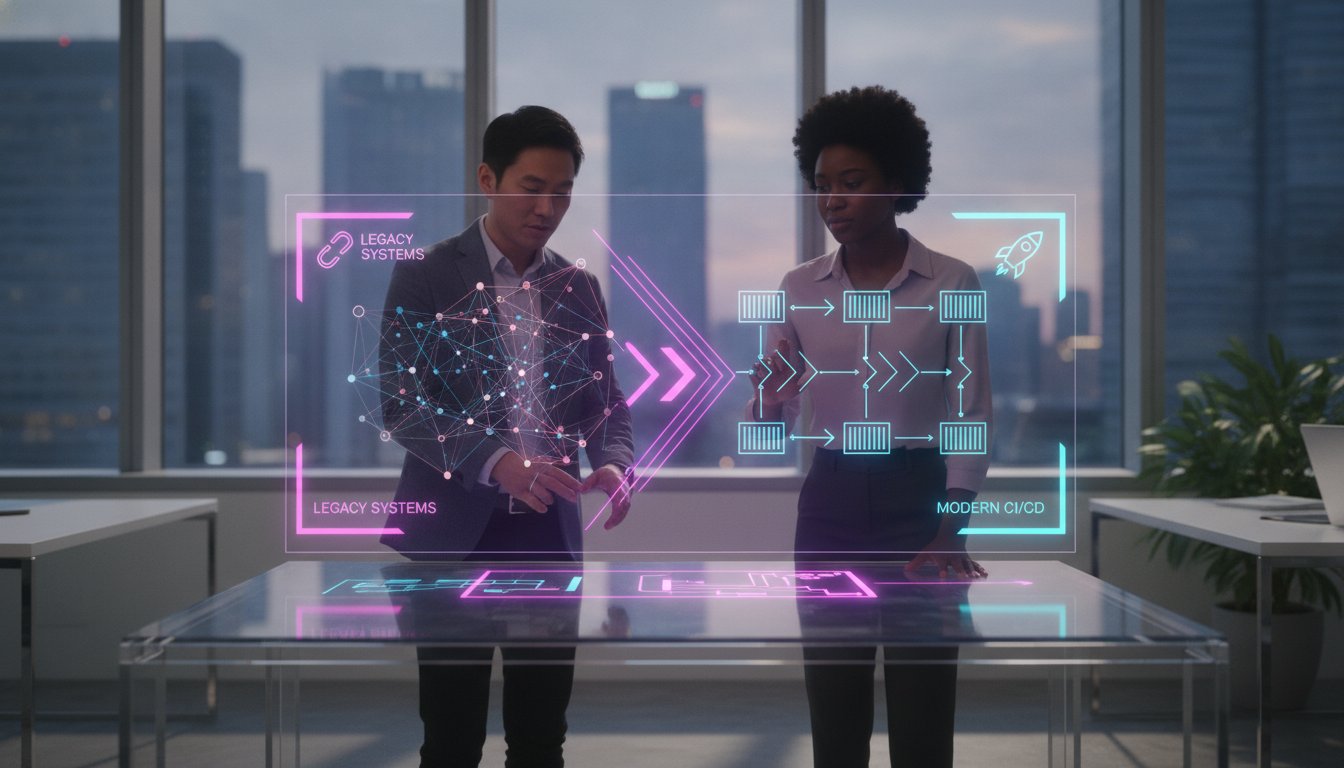
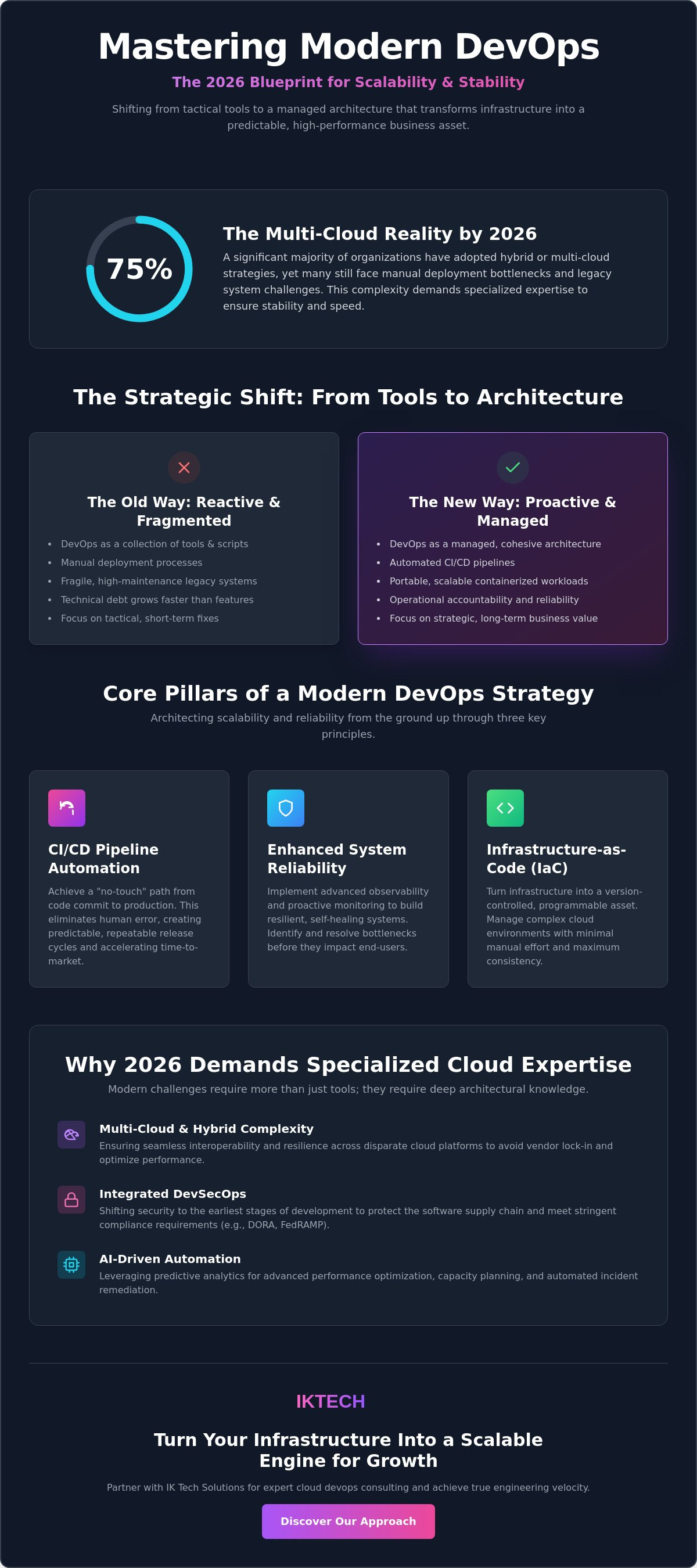
By 2026, 75% of organizations have adopted hybrid or multi-cloud strategies, yet many still face the same manual deployment bottlenecks that hindered them years ago. Enterprise modernization isn't just about moving workloads; it's about building an architecture that facilitates speed without compromising stability. Many leaders find that while they've adopted the cloud, their engineering teams remain trapped by fragile legacy systems and inefficient workflows. This is where professional cloud devops consulting shifts from a tactical fix to a strategic necessity. It provides the disciplined framework required to turn fragmented infrastructure into a predictable, high-performance business asset.
You likely recognize that scaling engineering talent is increasingly difficult and that technical debt often grows faster than your feature set. This article outlines how to master the architectural requirements of modern DevOps to transform your infrastructure into a reliable, scalable engine for growth. We'll examine the implementation of automated CI/CD pipelines, the transition to containerized environments using Kubernetes 1.36.2, and the strategic alignment needed to achieve predictable release cycles in a complex regulatory environment. By focusing on operational accountability and system-wide modernization, you can finally move beyond basic automation toward true engineering velocity.
Key Takeaways
- Understand the transition from treating DevOps as a collection of tools to implementing it as a managed architecture that's focused on operational accountability.
- Learn how to utilize containerization services and cloud-native technology stacks to transform legacy environments into portable, scalable workloads.
- Discover how specialized cloud devops consulting identifies hidden technical debt and establishes a disciplined roadmap for enterprise-wide modernization.
- Evaluate the strategic advantages of technical outsourcing as a means to access specialized engineering talent without the overhead of internal recruitment.
- Master the phases of infrastructure discovery and strategy design to achieve predictable release cycles and enhanced system reliability.
What is Cloud DevOps Consulting in 2026?
In 2026, cloud devops consulting has evolved from a technical service into a fundamental strategic partnership. It no longer focuses solely on the implementation of isolated tools but rather on the creation of a managed architecture that supports continuous infrastructure modernization. This shift reflects a move away from the traditional view of DevOps as a set of disconnected scripts; instead, it's now understood as a cohesive system designed to ensure operational stability and business agility. Modern consulting engagements prioritize the alignment of technical roadmaps with high-level business drivers, ensuring that every architectural decision directly supports the organization's bottom line.
High-impact consulting is distinct from general IT support or help desk services. While a help desk addresses immediate, reactive issues, a DevOps consultant functions as an architect who builds resilient, self-healing systems. These experts focus on foundational DevOps principles to transform how code is delivered and maintained. Enterprise efficiency in this era depends heavily on containerization and automated system implementation, moving beyond legacy virtual machines to more agile, cloud-native stacks. It's a disciplined approach that values long-term reliability over quick technical fixes.
The Core Objectives of Modern DevOps Engagements
The primary goal of a modern engagement is to accelerate time-to-market through robust CI/CD pipeline automation. By removing manual intervention from the deployment process, organizations achieve more predictable release cycles and fewer production errors. Reliability is equally critical; consultants implement advanced observability and proactive monitoring to identify bottlenecks before they impact the end user. Finally, reducing operational overhead is achieved via infrastructure-as-code (IaC) principles. These allow teams to manage complex environments with minimal manual effort and maximum consistency, effectively turning infrastructure into a programmable and version-controlled asset.
Why 2026 Demands Specialized Cloud Expertise
Managing the complexity of multi-cloud and hybrid-cloud environments is now a standard requirement. Research indicates that 75% of organizations utilize multiple providers to avoid vendor lock-in and enhance resilience. This complexity necessitates specialized expertise to ensure seamless interoperability across disparate platforms. Additionally, security requirements for containerized enterprise applications have become more stringent. This requires integrated DevSecOps practices that shift security to the earliest stages of development. The integration of AI-driven automation also plays a significant role in 2026, allowing teams to use predictive analytics for performance optimization and incident remediation. This level of sophistication requires cloud devops consulting that understands both the technical nuances and the evolving regulatory landscape, such as the EU's DORA or the latest FedRAMP requirements.
Architecting Scalability: Core Pillars of DevOps Strategy
Scalability in 2026 is not a byproduct of growth; it's an architectural requirement built into the foundation of the technology stack. Infrastructure modernization marks the shift from static, legacy virtual machines toward dynamic, cloud-native environments that respond automatically to load. Expert cloud devops consulting provides the blueprint for this transition, ensuring that the underlying systems are portable and resilient. This modernization process involves making strategic and informed decisions about which workloads benefit most from refactoring into microservices.
A "no-touch" path from code commit to production is the hallmark of a mature DevOps strategy. Automated CI/CD pipelines eliminate the human error associated with manual deployments, creating a predictable and repeatable delivery cycle. Security-by-design ensures that compliance checks and vulnerability scanning are not afterthoughts but integrated steps within this automated workflow. This proactive approach to security protects the software supply chain without slowing down the development team. If your current deployment process feels fragile, exploring specialized infrastructure modernization services can help stabilize your release cycles.
Containerization and Orchestration at Scale
The transition from monolithic architectures to microservices-based systems allows teams to scale specific components independently, rather than the entire application. Utilizing Kubernetes and Docker ensures that workloads remain portable across different cloud providers, which is essential for the 75% of organizations now pursuing multi-cloud strategies. Managing these environments requires a disciplined approach to orchestration:
- Cluster Governance: Implementing strict policies for Kubernetes clusters to ensure security and performance consistency.
- Resource Optimization: Fine-tuning CPU and memory limits to prevent "cloud sprawl" and keep infrastructure costs aligned with actual usage.
- Automated Scaling: Leveraging horizontal pod autoscaling to handle traffic spikes without manual intervention.
Infrastructure as Code (IaC) and Automation
Manual configuration is a primary source of technical debt and system instability. By using tools like Terraform and Ansible, teams can treat their infrastructure as repeatable, version-controlled code. This move toward immutable infrastructure patterns means that instead of patching existing servers, new ones are provisioned from a clean, validated template. This eliminates the "configuration drift" that often plagues large-scale environments. Implementing these practices through professional cloud devops consulting ensures that your automation logic remains as robust as the applications it supports. By treating infrastructure as version-controlled code, organizations can redeploy entire environments from scratch in minutes, drastically reducing recovery time after critical system failures.
Consulting vs. Strategic Outsourcing: Choosing the Right Model
Deciding how to resource a modernization initiative is a critical business decision that impacts both budget and project velocity. Short-term cloud devops consulting usually focuses on high-level strategy and architectural design, whereas long-term technical outsourcing addresses the ongoing execution and management of those systems. Organizations must weigh the speed of external talent against the desire for internal knowledge retention. Outsourcing provides immediate access to specialized engineering talent, bypassing the lengthy recruitment cycles and high overhead costs associated with internal hiring in a competitive market. It allows a business to maintain architectural control while leveraging external expertise to handle complex implementation tasks.
A hybrid approach often proves the most effective for large enterprises. In this model, you utilize consultants to build the strategic framework and define the technical roadmap, then rely on an outsourcing partner for the heavy lifting of execution. This ensures that the systems are designed by architects who understand high-level business drivers but are maintained by a dedicated team focused on operational excellence. This structure provides the flexibility to scale engineering capacity up or down based on the current phase of the modernization project.
When to Hire a DevOps Consultant
A consultant is most valuable when an organization needs an objective, high-level perspective to solve specific architectural challenges. They're typically brought in to audit existing infrastructure for bottlenecks and security vulnerabilities that internal teams might overlook. Their primary role is designing the initial architecture for a complex system implementation, ensuring the foundation is built on modern standards. Additionally, they serve as mentors, training internal teams on cloud-native best practices to ensure long-term self-sufficiency after the engagement ends.
The Benefits of Dedicated Technical Outsourcing
Technical outsourcing is designed for enterprises that need to scale their engineering capacity rapidly for high-impact modernization projects. It provides access to niche expertise in containerization and cloud-specific services that are often difficult to find in the general labor market. By partnering with a disciplined external provider, organizations can ensure consistent operational stability without the burden of managing a large internal DevOps department. This model prioritizes accountability; the partner takes full responsibility for the performance and reliability of the systems they manage. It's a pragmatic solution for businesses that want to focus on their core product while leaving infrastructure management to specialists. Engaging in cloud devops consulting to set the strategy followed by outsourcing for delivery creates a seamless path from planning to production.
The Modernization Roadmap: Implementing Cloud DevOps
Modernizing a legacy infrastructure requires a methodical approach that prioritizes operational stability at every stage. A structured roadmap ensures that engineering velocity doesn't outpace the system's reliability, transforming abstract goals into a series of disciplined, manageable phases. This process begins with a deep discovery phase and ends with a culture of continuous, data-driven improvement. Effective cloud devops consulting provides the oversight needed to navigate these stages without introducing new technical debt or disrupting existing business workflows.
- Phase 1: Discovery and Infrastructure Audit: The initial step involves a comprehensive evaluation of current systems to identify hidden technical debt and manual bottlenecks. This audit establishes the baseline for modernization.
- Phase 2: Strategy Design: Architects define the path forward, focusing on containerization goals and selecting the appropriate cloud-native tools, such as Kubernetes 1.36.2, to ensure future scalability.
- Phase 3: Implementation: This phase involves the actual construction of automated CI/CD pipelines and the deployment of Infrastructure as Code (IaC) frameworks to eliminate manual configuration.
- Phase 4: Optimization and Knowledge Transfer: Once the systems are live, the focus shifts to fine-tuning performance and ensuring your internal team has the skills to manage the new architecture long-term.
- Phase 5: Continuous Improvement: Using real-time performance monitoring and AIOps, the system is constantly refined to optimize costs and enhance user experience.
If your organization is ready to move beyond fragmented systems and manual deployments, explore our comprehensive system implementation services to begin your transition today.
Overcoming Common Implementation Roadblocks
Transitioning to a modern DevOps architecture often meets cultural resistance, as teams must move away from familiar, manual deployment workflows toward automated, "no-touch" systems. Managing the migration of legacy data to modern cloud environments also presents a significant challenge, requiring precise planning to ensure data integrity. Achieving zero-downtime during this transition is the gold standard; it requires a disciplined execution strategy that uses blue-green deployments or canary releases to maintain service availability while the new infrastructure comes online.
Measuring Success: Key DevOps Metrics
Success in a DevOps engagement is measured through concrete data rather than subjective impressions. Tracking Deployment Frequency (DF) allows leaders to measure engineering velocity and understand how quickly new features reach the market. Monitoring Lead Time for Changes (MLTC) identifies friction in the development workflow, highlighting areas where automation can be improved. Finally, analyzing Mean Time to Recovery (MTTR) serves as a critical benchmark for system resilience, proving that the new architecture can withstand and recover from failures with minimal impact on business operations.
Partnering for Operational Excellence: The IK Tech Solutions Approach
IK Tech Solutions approaches every engagement with a focus on operational stability and measurable success. We don't chase technical trends for their own sake; instead, we prioritize pragmatic solutions that align with your specific business outcomes. As a boutique firm with national reach, we specialize in solving complex, enterprise-level challenges that require more than just a surface-level fix. Our role in cloud devops consulting is to act as a disciplined operational partner. This means we take full responsibility for the systems we design and manage, ensuring they remain reliable assets rather than technical burdens.
Our deep expertise in high-impact technology architecture allows us to build environments that are both secure and scalable. We understand that modernization is a continuous process, not a one-time project. By focusing on accountability and transparency, we help organizations navigate the complexities of modern infrastructure with a steady, expert hand. Whether you're transitioning to a multi-cloud environment or optimizing existing containerized workloads, our approach ensures your technical roadmap remains aligned with your long-term strategic goals. We provide the structural integrity required to support engineering velocity at scale.
Custom Software Development Integrated with DevOps
Bespoke software performs best when it's built to leverage the specific strengths of its underlying infrastructure. Our custom software development teams work in close synergy with our DevOps architects to ensure maximum efficiency throughout the development lifecycle. This integration allows us to create cloud-native applications that are inherently designed for automated deployment and horizontal scaling. By building the software and the infrastructure in tandem, we eliminate the friction often found between development and operations teams. This results in faster delivery cycles and a more resilient product that can scale seamlessly as your user base grows.
Strategic Outsourcing for Scalable Growth
Many enterprises find that their internal capabilities are stretched thin by the demands of rapid modernization. We provide dedicated engineering talent through our outsourcing services to augment your existing team and accelerate project delivery. This model allows you to access specialized niche expertise without the delays and costs of a traditional hiring process. We manage complex system implementations from start to finish, providing the disciplined oversight necessary for success in high-stakes environments. Our goal is to provide the operational stability you need to focus on core business initiatives while we handle the intricacies of your cloud infrastructure.
Scale your engineering capabilities with IK Tech Solutions and transform your infrastructure into a predictable, high-performance business asset.
Securing Operational Stability Through Strategic Modernization
Modernizing an enterprise infrastructure is a complex undertaking that requires more than just technical automation; it demands a disciplined architectural framework. We've explored how moving toward cloud-native stacks and containerization services provides the necessary foundation for portable, scalable workloads. By following a structured modernization roadmap, organizations can eliminate manual bottlenecks and achieve predictable release cycles that align with long-term business drivers. This shift ensures that your technology serves as a growth engine rather than a source of technical debt.
Achieving this level of operational excellence requires a partner who prioritizes accountability and measurable results. Professional cloud devops consulting ensures that your transition to advanced environments, such as Kubernetes clusters, is managed with a steady, expert hand. IK Tech Solutions specializes in high-impact infrastructure modernization and pragmatic, outcome-driven strategies for national enterprises. Our focus remains on delivering stability and efficiency through expert system implementation and bespoke engineering that scales with your needs.
If you're ready to transform your fragmented systems into a reliable business asset, Consult with a DevOps Architect at IK Tech Solutions. Building a resilient, automated future starts with a single, strategic step toward modernization.
Frequently Asked Questions
What is the primary difference between DevOps consulting and IT support?
The primary difference lies in the strategic scope; DevOps consulting is an architectural partnership focused on infrastructure modernization, while IT support is typically a reactive service for immediate technical issues. A consultant designs self-healing, automated systems that prevent bottlenecks before they occur. This proactive approach prioritizes long-term operational excellence over short-term troubleshooting and hardware maintenance.
How does containerization improve our cloud infrastructure efficiency?
Containerization improves efficiency by isolating applications into portable units that share the host operating system's kernel, which significantly reduces resource overhead compared to traditional virtual machines. By utilizing Kubernetes 1.36.2 for orchestration, teams can automate the scaling and management of these containers. This ensures that your infrastructure remains responsive to traffic fluctuations while maintaining high density and optimal resource utilization.
Can DevOps consulting help reduce our monthly cloud expenditure?
Specialized cloud devops consulting directly addresses cloud expenditure by implementing FinOps principles and automated resource management. Consultants analyze your infrastructure to identify underutilized resources and right-size your environment, ensuring that your cloud spend is directly tied to actual performance requirements. This structured approach reduces the waste often found in unmanaged, legacy cloud setups that lack automated scaling.
What cloud platforms do your DevOps experts specialize in?
Experts in this field specialize in the leading global platforms, including Amazon Web Services (AWS), Microsoft Azure, and Google Cloud Platform (GCP). Since 75% of organizations now utilize hybrid or multi-cloud strategies, the focus is on creating consistent deployment workflows that function seamlessly across different providers. This expertise ensures that your infrastructure remains resilient and avoids the risks associated with single-vendor lock-in.
How long does a typical infrastructure modernization project take?
A typical infrastructure modernization project managed through professional cloud devops consulting generally follows a timeline of three to nine months, depending on the scale of the legacy technical debt. This duration allows for a methodical progression through discovery, architectural design, and the implementation of automated CI/CD pipelines. A phased approach ensures that modernization occurs without disrupting existing business operations during the transition.
Is DevOps outsourcing suitable for highly regulated industries?
DevOps outsourcing is particularly effective for highly regulated industries because it provides access to specialists who understand compliance-as-code. These partners ensure that your systems adhere to frameworks like the EU's Digital Operational Resilience Act (DORA) or FedRAMP rules. By automating compliance checks within the development lifecycle, you maintain audit-readiness without sacrificing the velocity or efficiency of your engineering teams.
What is the ROI of implementing an automated CI/CD pipeline in 2026?
The ROI of automated CI/CD pipelines in 2026 is driven by a drastic reduction in deployment-related downtime and a faster time-to-market for new features. By removing manual intervention from the release process, organizations lower the operational costs of engineering and improve the reliability of their software. This leads to higher customer satisfaction and more predictable business outcomes through accelerated, stable delivery cycles.
How do you handle security within the DevOps lifecycle (DevSecOps)?
Security is handled by implementing DevSecOps practices that shift security responsibilities to the earliest stages of development. This involves embedding automated vulnerability scanning, secret detection, and compliance checks directly into the CI/CD pipeline. By automating these security layers, every code change is validated against your organization's security policies before it reaches production, reducing the risk of vulnerabilities in the software supply chain.