
Nearshore DevOps Services: A Strategic Framework for Infrastructure Modernization in 2026

The traditional view of outsourcing as a mere cost-cutting measure is officially obsolete in the 2026 engineering landscape. Many CTOs find that the primary bottleneck isn't just the hourly rate of local talent, but the widening gap between legacy infrastructure and the demands of cloud-native scaling. You've likely felt the friction of senior DevOps talent scarcity and CI/CD pipelines that simply can't keep pace with your development team's output. Integrating nearshore devops services has transitioned from a budget tactic into a strategic necessity for organizations that require high-level architectural expertise without the friction of significant time zone offsets.
You need more than just extra hands; you need a disciplined partner capable of dismantling architectural debt and implementing containerized environments that actually perform. This article demonstrates how a structured nearshore model provides the technical depth required to accelerate your release cycles while maintaining a seamless extension of your internal culture. We'll explore a framework for infrastructure modernization that prioritizes operational stability, integrates AI-driven automation, and ensures your engineering velocity remains uncompromised by management overhead.
Key Takeaways
- Analyze the transition toward Platform Engineering as a primary driver for infrastructure modernization in the current 2026 environment.
- Learn how nearshore devops services provide the architectural depth necessary to modernize legacy systems and accelerate release cycles without the management tax of traditional outsourcing.
- Identify the essential components of a stable infrastructure, including Infrastructure as Code (IaC) for repeatable environments and continuous validation for reliable delivery.
- Discover how a "One-Team" approach reduces operational overhead by integrating senior specialists directly into your existing communication channels and project management workflows.
- Evaluate the strategic impact of prioritizing architectural integrity and system reliability to ensure sustainable scaling and reduced technical debt.
The Evolution of Nearshore DevOps Services in 2026
The standard for software delivery has undergone a fundamental shift. In 2026, success is no longer measured simply by the frequency of deployments, but by the resilience and scalability of the underlying platform. Modern nearshore devops services have evolved to meet this demand, moving beyond the outdated model of basic labor arbitrage to become high-context engineering partnerships. This evolution is driven by the rise of Platform Engineering, where the focus isn't just on automating a single pipeline but on building internal developer platforms that empower product teams. Organizations are no longer looking for vendors to handle tickets; they're seeking partners who can take full architectural responsibility for complex cloud environments.
This transition reflects a deeper understanding of DevOps principles, prioritizing long-term system health over short-term speed. The 2026 landscape requires a disciplined approach to infrastructure modernization that integrates security, observability, and cost-optimization into the initial design. By leveraging nearshore devops services, enterprises can secure senior talent that functions as a direct extension of their internal team, effectively closing the talent gap while maintaining the high level of context necessary for complex system implementation.
The Problem with Traditional Offshore Models
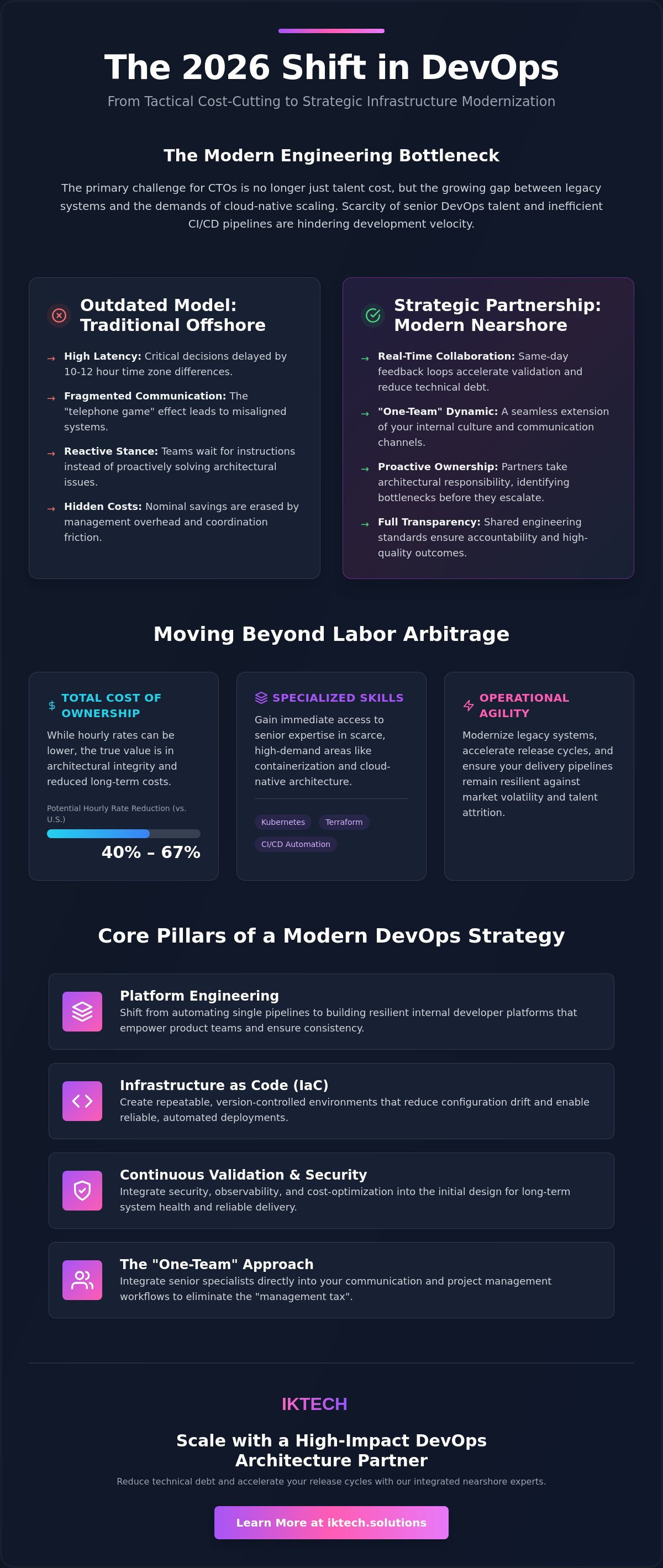
Traditional offshore outsourcing often creates a "telephone game" effect that is catastrophic for modern infrastructure. When complex technical requirements are passed across 10 or 12 time zones, the resulting communication latency slows down critical decision-making. Agile ceremonies become fragmented, and the lack of real-time interaction often leads to cultural misalignment regarding engineering ownership. Offshore teams frequently fall into a reactive stance, waiting for explicit instructions rather than proactively identifying architectural bottlenecks. These hidden costs of coordination often outweigh the nominal savings in hourly rates, leaving internal leaders to manage the fallout of misaligned systems.
Nearshore as a Strategic Engineering Extension
Geographic proximity is a primary driver of project accountability and transparency. Nearshore models facilitate real-time collaboration, which is a non-negotiable requirement for high-velocity DevOps environments. Same-day feedback loops ensure that infrastructure changes are validated immediately, preventing the accumulation of technical debt. This alignment extends to shared engineering standards, where both internal and nearshore teams operate on the same protocols for documentation, testing, and security. By working within similar time zones, the partnership achieves a "One-Team" dynamic that feels natural and integrated, allowing for a level of transparency that offshore models simply cannot replicate.
Strategic Advantages: Moving Beyond Labor Arbitrage
The decision to engage nearshore devops services has moved past the era of looking for the lowest hourly rate. While research indicates that developers in nearshore locations can be 40% to 67% less expensive per hour than their U.S. counterparts, the true strategic advantage lies in the total cost of ownership (TCO) and architectural integrity. According to Deloitte's 2024 Global Outsourcing Survey, executive focus has shifted toward acquiring specialized skills and enhancing operational agility. This shift is critical because saving on labor is irrelevant if the resulting infrastructure creates long-term technical debt that stalls your product roadmap.
Strategic partnerships provide immediate access to expertise in containerization and cloud-native architectures that are often too expensive or scarce to source locally. By diversifying engineering hubs across multiple geographic regions, organizations also mitigate the risk of localized outages or talent attrition. This redundancy ensures that your infrastructure remains resilient and your delivery pipelines stay operational regardless of external market volatility. It's about building a foundation that supports continuous growth rather than just patching existing holes in the system.
Infrastructure Modernization as a Growth Lever
Legacy systems often act as an anchor, preventing the rapid deployment of new features. Modernizing these systems through containerization and microservices allows for a more modular, scalable environment. This transition is a core component of digital transformation; it enables teams to deploy code with confidence. If your organization is struggling with bottlenecked pipelines, infrastructure modernization services can provide the necessary framework to restore engineering velocity and ensure your systems are ready for future scaling.
Scaling Engineering Capabilities Sustainably
The "hiring trap" occurs when companies spend months searching for senior DevOps engineers while their current systems degrade. A nearshore partner bypasses this delay by providing instant, senior-level expertise. This allows your internal team to maintain focus on core business logic and product innovation while the partner manages the underlying infrastructure complexity. You gain the flexibility to scale team size based on the specific requirements of your project lifecycle. It's a disciplined approach that ensures you never pay for idle capacity while always having the technical depth required for complex nearshore devops services implementation.
Core Pillars of a Modern Nearshore DevOps Strategy
Successful infrastructure modernization relies on more than high-level strategic goals. It requires a disciplined technical framework that integrates every stage of the development lifecycle into a cohesive, automated system. When implementing nearshore devops services, the focus must remain on building a foundation that supports both current stability and future scalability. This framework is built upon five core pillars that ensure your infrastructure remains a competitive advantage rather than a liability.
- Infrastructure as Code (IaC): Establishing version-controlled, repeatable environments to eliminate configuration drift.
- Automated CI/CD Pipelines: Achieving "no-drama" releases through continuous validation and automated testing cycles.
- Advanced Containerization: Leveraging Kubernetes and Docker to ensure environment parity across the entire lifecycle.
- Observability and Monitoring: Moving from reactive alerts to proactive system health through deep telemetry data.
- Security Integration (DevSecOps): Embedding compliance and security checks directly into the automated workflow.
A proactive approach to observability allows teams to identify potential bottlenecks before they impact the end-user experience. By collecting and analyzing logs, metrics, and traces, engineers gain a comprehensive view of system behavior. This transparency is essential for maintaining operational stability in complex, distributed environments. Furthermore, integrating security early in the pipeline ensures that every deployment adheres to strict organizational standards without compromising delivery speed.
Infrastructure as Code and Automation
Manual configuration is a primary source of operational risk and inconsistency. Utilizing tools like Terraform and Ansible allows engineers to define entire environments through declarative code, which significantly reduces the likelihood of human error. Infrastructure as Code (IaC) is the foundation of modern system implementation. This shift toward immutable infrastructure ensures that servers are never modified after deployment; instead, new instances are provisioned from updated images to maintain a predictable state across the cloud environment.
Containerization and Orchestration at Scale
Managing complex microservices requires robust orchestration to handle scaling and service discovery. Kubernetes (K8s) has become the industry standard for managing container lifecycles, often supplemented by service meshes to manage inter-service communication and security. These technologies optimize resource utilization, which directly reduces cloud expenditure by ensuring that workloads only consume the necessary compute power. By maintaining strict consistency across development, staging, and production environments, nearshore devops services ensure that deployments remain predictable, resilient, and fully portable across different cloud providers.
Overcoming the "Management Tax" in Nearshore Partnerships
Engineering leaders often hesitate to outsource because they fear a "management tax", the idea that overseeing an external team requires more effort than managing internal staff. This friction usually stems from fragmented communication and misaligned workflows rather than geographic distance. High-performing nearshore devops services eliminate this burden by integrating directly into your existing ecosystem. By adopting the same tools and communication cadences, the external team functions as a natural extension of your engineering department rather than a separate vendor to be managed.
Establishing a "One-Team" culture is essential for reducing overhead. This integration relies on shared Slack channels, Jira boards, and unified documentation standards. When knowledge is documented and shared openly, you eliminate the information silos that typically lead to delays and misunderstandings. A dedicated DevOps Architect plays a critical role here. They act as the bridge between high-level business objectives and technical execution, ensuring that every infrastructure change serves a specific strategic purpose. This professional oversight ensures that your internal managers don't have to micromanage technical details.
A 5-Step Framework for Seamless Integration
Success requires a methodical approach to onboarding and ongoing collaboration. Following a structured framework ensures that both teams remain aligned on priorities and performance standards from day one.
- Step 1: Architectural Audit. Conduct a thorough review of the current infrastructure to identify bottlenecks and existing technical debt.
- Step 2: Define Shared KPIs. Align on DORA metrics, including deployment frequency, lead time for changes, and mean time to recovery (MTTR).
- Step 3: Synchronous Rhythms. Establish daily stand-ups and sprint planning sessions within overlapping work hours to ensure real-time problem-solving.
- Step 4: Automated Governance. Implement security guardrails and policy-as-code to ensure compliance without manual intervention.
- Step 5: Continuous Feedback. Schedule monthly reviews to evolve the infrastructure roadmap based on changing business needs.
Ensuring Accountability and Transparency
Transparency is maintained through automated reporting and data-driven insights. By using dashboards that track infrastructure performance and project milestones in real time, stakeholders always have a clear view of progress. Regular strategic reviews with senior technical leadership reinforce this accountability and ensure the partnership stays focused on long-term value. Trust isn't built through vague promises; it's established through a steady hand, operational stability, and clear communication. If you're looking to scale your engineering capabilities without increasing your management burden, explore our DevOps and cloud services to see how we integrate with your team.
Scaling with IK Tech Solutions: High-Impact DevOps Architecture
The modern enterprise requires more than just reactive fixes; it needs a disciplined architectural partner that understands the intersection of business logic and system performance. IK Tech Solutions provides nearshore devops services that prioritize operational stability and measurable outcomes over technical jargon. We position ourselves as seasoned architects who bring order to complex environments, ensuring that every modernization effort aligns with your long-term engineering goals. By focusing on high-impact system implementation rather than basic IT support, we provide the technical depth necessary to manage intricate cloud-native lifecycles.
Our approach integrates custom software development with modern DevOps practices to create a unified delivery ecosystem. This ensures that your applications are not just built well, but are also supported by a resilient, containerized infrastructure that scales automatically. We take full responsibility for the systems we manage, providing a level of accountability that simple staff augmentation models cannot match. This disciplined methodology allows your internal teams to focus on innovation while we handle the complexities of infrastructure modernization and performance optimization.
Strategic Outsourcing for the Modern Enterprise
We design our services specifically for US-based enterprise engineering teams that require high-context partnerships. This isn't about providing generic labor; it's about acting as a strategic extension of your internal culture. We focus on high-impact modernization projects that eliminate delivery friction and reduce technical debt. By tailoring our solutions to your specific operational requirements, we ensure that your digital infrastructure becomes a growth lever rather than a bottleneck. Our expertise in complex system implementation allows us to navigate the challenges of legacy modernization with precision and transparency.
Ready to Modernize Your Infrastructure?
The strategic value of nearshore devops services in 2026 lies in the ability to provide high-level expertise with minimal management overhead. Choosing a partner that takes full responsibility for system stability is the most effective way to scale your engineering velocity without sacrificing quality. As you look toward the next phase of your digital transformation, the right architectural framework will be the difference between sustainable growth and operational stagnation. It's time to move beyond traditional outsourcing and adopt a model built on reliability, transparency, and technical excellence. You can consult with an IK Tech Solutions architect to audit your DevOps pipeline and begin the process of modernizing your infrastructure today.
Building a Resilient Engineering Foundation
The 2026 engineering landscape requires a fundamental shift from reactive troubleshooting to proactive architectural design. By prioritizing infrastructure modernization through containerization and automated validation, organizations can achieve the velocity necessary to remain competitive. You've seen how nearshore devops services provide the technical depth and cultural alignment required to scale without the friction of extreme time zone differences or excessive management overhead.
Success depends on a partner who understands that technical implementation must serve specific business outcomes. IK Tech Solutions brings a pragmatic, no-nonsense engineering culture to every project, specializing in complex system implementation and Kubernetes orchestration. We act as a steady hand for your digital infrastructure, ensuring that your systems are resilient, secure, and fully optimized for future growth. It's time to transform your delivery pipeline into a high-performance engine that supports your long-term roadmap.
Partner with IK Tech Solutions for Strategic DevOps Modernization
Take the next step toward a modernized, scalable environment that empowers your development team to deliver with confidence.
Frequently Asked Questions
What is the difference between nearshore and offshore DevOps?
Nearshore DevOps refers to partnerships located in similar time zones, whereas offshore models typically involve geographic gaps of 10 to 12 hours. This proximity allows for real-time collaboration and synchronous agile ceremonies that are often impossible with offshore teams. Nearshore models focus on high-context engineering alignment and synchronous communication rather than just low-cost labor arbitrage.
How do nearshore DevOps services handle data security and compliance?
Nearshore partners maintain compliance by integrating security guardrails directly into the CI/CD pipeline through DevSecOps practices. They adhere to international data protection standards such as GDPR, HIPAA, or CCPA depending on your specific industry requirements. Reliable providers use automated governance and policy-as-code to ensure that every infrastructure change meets your organization's strict security protocols.
Can a nearshore DevOps team integrate with our existing in-house engineers?
A nearshore team integrates by functioning as a "One-Team" extension through shared communication channels like Slack and project management tools like Jira. This integration is successful because overlapping work hours allow for daily stand-ups and real-time troubleshooting. Standardized documentation and shared engineering protocols ensure that the external specialists work seamlessly alongside your internal developers without creating information silos.
What are the typical cost savings when moving to a nearshore DevOps model?
Organizations often report cost savings between 20% and 40% when utilizing nearshore devops services compared to the total cost of hiring senior local talent. These savings result from lower hourly rates in regions like Latin America or Central Europe and reduced overhead for benefits and infrastructure. However, the most significant value comes from the reduced total cost of ownership achieved through modernized, efficient systems.
How does nearshore DevOps improve our software release frequency?
Nearshore DevOps improves release frequency by eliminating manual bottlenecks through automated CI/CD pipelines and Infrastructure as Code. By reducing the lead time for changes and implementing continuous validation, teams can move from monthly deployments to multiple releases per day. This acceleration is driven by the implementation of repeatable, containerized environments that ensure consistency across the entire development lifecycle.
What technical stack should a nearshore DevOps partner be proficient in?
A proficient partner must demonstrate expertise in industry-standard tools including Kubernetes for orchestration, Docker for containerization, and Terraform for Infrastructure as Code. They should also possess deep knowledge of major cloud platforms like AWS, Azure, or GCP. Proficiency in nearshore devops services also requires experience with CI/CD tools like GitHub Actions and monitoring platforms such as Prometheus or Datadog.
How do we measure the ROI of a nearshore DevOps consulting engagement?
ROI is measured through DORA metrics, specifically deployment frequency, lead time for changes, mean time to recovery (MTTR), and change failure rate. You should also evaluate the reduction in cloud expenditure and the decrease in developer downtime. A successful engagement results in higher engineering velocity and a significant reduction in the technical debt that previously stalled your product roadmap.
What happens if our internal team uses different tools than the nearshore partner?
If your internal team uses different tools, a seasoned partner will either adapt to your existing stack or provide a strategic migration plan to more efficient alternatives. The focus remains on the operational outcome rather than the specific software. Standardizing on a unified toolset is usually recommended during the modernization process to ensure transparency and maintain a single source of truth for the infrastructure.