
Software Development Industry Challenges: A 2026 Strategic Analysis

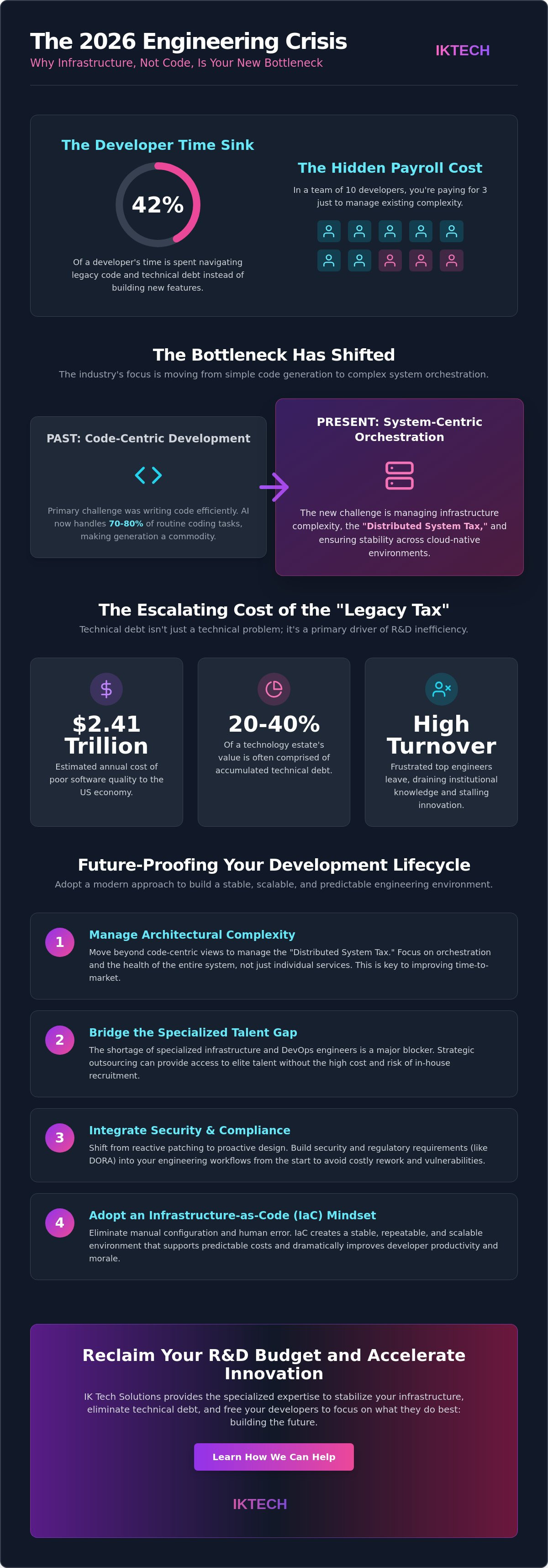
If your engineering team consists of ten developers, you're likely paying for three of them just to manage the weight of existing technical debt. As of mid-2026, developers spend up to 42% of their time navigating legacy code and architectural inefficiencies rather than building new features. This reality highlights the core software development industry challenges that have shifted the focus from simple code production to complex system orchestration.
You've likely noticed that while AI tools can generate scripts in seconds, the cognitive cost of maintaining that code often offsets the initial speed gains. It's a frustrating paradox where velocity increases but stability remains elusive. This article provides a pragmatic deep-dive into the structural and operational hurdles facing enterprise engineering today, from the shortage of specialized DevOps talent to the compliance demands of the Digital Operational Resilience Act. By addressing these bottlenecks directly, you'll learn how to stabilize your infrastructure, ensure predictable costs, and ultimately reduce your time-to-market.
Key Takeaways
- Identify why managing architectural complexity and the "Distributed System Tax" is now more critical for time-to-market than simple code production.
- Analyze the financial impact of legacy rigidity to better allocate your R&D budget toward innovation rather than maintenance.
- Evaluate strategic outsourcing as a viable solution to the shortage of specialized infrastructure engineers and the high cost of failed in-house recruitment.
- Learn to integrate security and regulatory compliance directly into your engineering workflows to address current software development industry challenges and avoid reactive patching.
- Adopt an Infrastructure-as-Code (IaC) mindset to create a stable, scalable environment that supports predictable development costs and improved developer productivity.
The 2026 Complexity Crisis: Moving Beyond Code-Centric Development
In 2026, the act of writing code has become a secondary concern for most enterprise leaders. With AI now capable of handling 70% to 80% of routine coding tasks, the bottleneck has shifted from syntax to structure. The most pressing software development industry challenges now reside in the architectural layers that support the application. Organizations find that while they can generate features faster than ever, they can't deploy or maintain them with the same agility. This disconnect is fueled by the "Distributed System Tax," where the operational overhead of managing microservices often outweighs the benefits of modularity.
The Complexity Crisis is the primary 2026 industry blocker, characterized by the widening gap between the ease of code generation and the extreme difficulty of managing the underlying infrastructure.
Many teams are struggling because cloud-native environments have evolved faster than the average developer's skill set. These software development industry challenges are compounded by the fact that it's no longer enough to understand a programming language; engineers must now navigate a labyrinth of service meshes, serverless functions, and ephemeral nodes. This evolution has made traditional, code-centric development obsolete. Success now depends on how well a team manages the environment, not just the logic within it.
The Orchestration Overhead
Managing Kubernetes and containerized environments at scale has become a specialized discipline that generalist teams often find impenetrable. Manual infrastructure management is a non-starter for modern enterprises because the sheer volume of configuration points makes human error almost certain. To maintain operational stability, organizations must transition toward fully automated CI/CD pipelines. This shift ensures that every stage of the software development lifecycle is governed by code rather than manual intervention, which allows for rapid iteration without compromising system integrity. Containerization services are no longer optional; they're the baseline for any scalable enterprise.
Data Fragmentation and Integration Hurdles
Operating across hybrid and multi-cloud environments introduces significant data consistency issues that threaten business intelligence. When services are scattered across different cloud providers, maintaining a "single source of truth" becomes impossible without a unified data architecture. These integration hurdles often lead to high hidden costs during system implementation, where a significant portion of a technology estate's value is drained by technical debt. Strategic planning in the early phases is the only way to prevent these technical units from becoming siloed. Without a cohesive strategy, the Complexity Crisis will continue to erode the ROI of even the most advanced software projects.
The Escalating Cost of Technical Debt and Legacy Rigidity
Technical debt is no longer a footnote in quarterly reports; it's a primary driver of R&D inefficiency. In 2026, developers spend an average of 33% to 42% of their time managing technical debt rather than innovating. This "Legacy Tax" functions as a hidden payroll expense where organizations pay for full-time engineering capacity but receive only a fraction of that in new feature development. When poor software quality costs the US economy an estimated $2.41 trillion annually, the financial stakes of these software development industry challenges are undeniable. It's estimated that 20% to 40% of the value of a typical technology estate is comprised of this accumulated debt, which creates a significant drag on innovation.
The impact extends beyond the balance sheet to affect developer retention and morale. High-performing engineers often leave organizations where they spend more time patching fragile systems than building new solutions. This frustration creates a cycle of turnover that drains institutional knowledge and makes modernization even more difficult. Technical debt acts as compound interest against business agility, where every new feature requires more effort to implement than the last because of the underlying friction.
Identifying Silent Killers in Your Infrastructure
Architectural decay often begins with "zombie" dependencies, where unpatched legacy libraries remain embedded in the system long after they've lost support. These vulnerabilities are frequently shielded by outdated requirements and restrictive policies that prevent teams from taking necessary risks to update them. Documentation gaps are the single biggest hurdle here. Without a clear map of how systems interact, engineers are forced to treat the codebase like a black box. This lack of transparency leads to "lift and shift" migration failures that simply relocate rigidity to the cloud without solving the core issues.
Strategies for Pragmatic Modernization
A total system rewrite is rarely the most cost-effective path. Instead, successful organizations prioritize incremental refactoring to manage their software development industry challenges. By leveraging containerization services, teams can isolate legacy components and upgrade them without disrupting the entire ecosystem. This approach allows for infrastructure modernization that extends the software lifespan while maintaining operational stability. Focusing on these high-impact technical units ensures that development costs remain predictable even as the system grows in complexity. This methodical transition helps teams regain their velocity without the high risk of a "big bang" replacement.
Bridging the Specialized Talent Gap Through Strategic Outsourcing
The 2026 labor market is sharply polarized. While routine coding tasks are increasingly automated, the demand for senior, specialized engineers has reached a fever pitch. Generalist developers often lack the deep infrastructure knowledge required to manage modern, multi-cloud environments, leading to bottlenecks that stall production. These software development industry challenges are exacerbated by challenges in hiring skilled staff for specialized roles in areas like AI, machine learning, and cloud architecture. When you can't find the right talent locally, your time-to-market inevitably suffers.
Recruiting in-house for these positions is a high-risk investment. With average senior salaries exceeding $134,000 and aggressive competition for talent, a failed hire can set a project back by months. Strategic outsourcing offers a more disciplined alternative. This isn't traditional "body shopping" where you simply add headcount. Instead, it represents a high-level engineering partnership where specialized technical units take responsibility for complex systems. By offloading infrastructure management and system implementation to experts, you allow your internal teams to focus on core product innovation and business logic.
The DevOps and Cloud Architect Shortage
DevOps expertise remains the most contested resource in the 2026 market. Many organizations suffer from "DevOps Silos" where knowledge is concentrated in a few individuals, creating single points of failure. External consultants break these silos by introducing standardized, automated processes that your internal staff can eventually maintain. Leveraging technical outsourcing for niche containerization expertise ensures that your systems remain scalable and secure without the overhead of a permanent, specialized hire. This approach transforms DevOps from a bottleneck into a strategic advantage.
Managing the Hybrid Engineering Workforce
Integrating outsourced talent requires a methodical approach to maintain accountability. You shouldn't treat external partners as separate entities; they must function as a disciplined extension of your core team. Establishing clear KPIs for technical outsourcing success is essential for tracking progress and ensuring quality standards. This hybrid model succeeds when there's a seamless flow of communication and shared responsibility for the system's performance. When managed correctly, this collaboration accelerates the professional development of your internal staff by exposing them to high-level architectural practices and modern software development industry challenges.
Security and Compliance: From Afterthought to Architectural Baseline
Starting in 2026, security is no longer an optional layer added at the end of a project. With the Digital Operational Resilience Act (DORA) taking full effect in January 2026, financial institutions and their IT providers must implement real-time risk monitoring and strict incident notification timelines. Additionally, the EU Cyber Resilience Act (CRA) mandates that manufacturers report actively exploited vulnerabilities within 24 hours starting September 11, 2026. These regulations have transformed compliance from a checklist into a core engineering requirement. Tech leaders are responding; in late 2025, 51% identified security as the primary hurdle among software development industry challenges.
Reactive security measures often result in catastrophic financial losses through regulatory fines and brand erosion that far exceed the cost of proactive implementation.
To manage this risk, enterprises are moving toward "Secure-by-Design" principles where security is integrated into every stage of the development lifecycle. DevSecOps practices automate compliance by embedding vulnerability scanning and policy enforcement directly into the CI/CD pipeline. This shift-left approach ensures that potential threats are mitigated before they reach production, reducing the operational burden on security teams. If you need to modernize your security posture, our experts can help you implement secure-by-design infrastructure today.
Automating the Security Perimeter
Implementing automated scanning for containerized environments is critical for maintaining a stable infrastructure. Modern software development industry challenges require a "Zero Trust" architecture where no user or system is trusted by default, regardless of their location on the network. By automating the security perimeter, organizations can achieve rapid deployment cycles while simultaneously reducing their window of exposure to new exploits. This automated approach ensures that security scales alongside your application without requiring constant manual oversight.
Supply Chain Security in Software Development
Software Bill of Materials (SBOM) has become an essential tool for managing the risks inherent in open-source libraries and third-party APIs. In 2026, you can't afford to ignore the security posture of your upstream dependencies. Vetting your outsourcing partners for robust security protocols is equally vital to ensure that external talent doesn't introduce vulnerabilities into your ecosystem. A disciplined approach to supply chain security involves continuous monitoring of all external components to prevent a single compromised library from jeopardizing your entire system.
Future-Proofing Your Development Lifecycle for 2026 and Beyond
Solving the 2026 software development industry challenges requires a fundamental shift from reactive patching to proactive architectural design. Adopting an Infrastructure-as-Code (IaC) mindset is the first step toward this maturity. It ensures that your environment is as version-controlled and transparent as your application code. This transparency reduces the "comprehension debt" often associated with complex, undocumented systems. Simultaneously, investing in developer experience (DevEx) is no longer a luxury. It's a strategic necessity to maximize the productivity of your existing talent in a polarized labor market.
Continuous modernization must become a permanent part of your development cycle. This prevents the accumulation of technical debt that previously drained R&D budgets and stalled innovation. AI-assisted development tools should be used to augment senior engineers by handling routine logic, which allows them to focus on high-level system design and orchestration. This balanced approach ensures that your team remains lean and effective without sacrificing the deep architectural oversight required for operational stability. Velocity isn't enough; it must be matched by structural integrity.
Building a Resilient Engineering Culture
Organizations must move away from the "Feature Factory" model where success is measured solely by output volume. Instead, a "Value-Driven" development model prioritizes outcomes and system reliability over simple ticket completion. This shift requires deep cross-functional collaboration between development, operations, and security teams to eliminate silos. Long-term strategic implementation always outperforms short-term fixes that eventually lead to system failure. Culture is the foundation upon which technical excellence is built.
How IK Tech Solutions Navigates These Challenges
Navigating these software development industry challenges requires a partner who understands the intersection of technology and business performance. IK Tech Solutions provides high-impact infrastructure modernization that transforms fragile systems into scalable, resilient environments. We accelerate your delivery through specialized DevOps and cloud engineering consulting, ensuring that your pipelines are both fast and secure. Whether you need containerization services or custom software development tailored for long-term growth, our team brings the disciplined, operational expertise necessary to bring order to complex technical environments. It's time to move beyond managing complexity and start leveraging it for competitive advantage.
Architecting Operational Stability in an Era of Complexity
The transition toward 2027 requires more than just faster coding cycles; it demands a disciplined approach to infrastructure and architectural integrity. We've analyzed how the "Distributed System Tax" and escalating technical debt can erode R&D budgets if left unmanaged. Success in this environment depends on your ability to integrate security as an architectural baseline while leveraging specialized talent to bridge internal skill gaps. These software development industry challenges are structural in nature and require a long-term strategic implementation rather than short-term fixes.
Navigating this complexity is easier with a reliable operational partner. Partner with IK Tech Solutions to modernize your infrastructure and scale your engineering capabilities. Our team provides specialized DevOps and cloud infrastructure expertise to help you achieve enterprise efficiency through strategic technical outsourcing. We have a proven track record in high-impact system implementation that turns technical debt into operational stability. You can build a resilient engineering culture that thrives on complexity instead of being slowed by it.
Frequently Asked Questions
What is the biggest challenge in software development in 2026?
The primary challenge in 2026 is managing architectural complexity rather than simply writing code. While AI tools have accelerated code generation, the difficulty of orchestrating microservices and multi-cloud environments has created a "Complexity Crisis." Organizations now face significant software development industry challenges related to the operational overhead required to keep these systems stable and scalable.
How does technical debt impact software development industry challenges?
Technical debt functions as a direct drain on innovation by consuming up to 42% of an engineering team's weekly capacity. It creates a cycle of legacy rigidity where new features become increasingly expensive and risky to implement. This accumulated debt acts as compound interest against business agility, forcing teams to prioritize maintenance over the delivery of new market value.
Why is DevOps consulting more effective than hiring generalist developers?
DevOps consulting provides specialized architectural expertise that generalist developers typically don't possess. While a generalist can build features, they often lack the deep infrastructure knowledge needed to automate CI/CD pipelines or manage Kubernetes at scale. Consultants bring standardized processes and objective oversight, which helps break internal silos and ensures that your infrastructure supports long-term reliability.
Can outsourcing software development help with infrastructure modernization?
Strategic outsourcing is a highly effective method for accelerating infrastructure modernization. By partnering with a specialized engineering firm, enterprises can offload the risks of complex system implementation to experts with a proven track record. This approach allows internal teams to remain focused on core product development while the external partner handles the heavy lifting of containerization and cloud migration.
What are the security risks of legacy software systems in 2026?
Legacy systems in 2026 present severe security risks due to "zombie" dependencies and unpatched libraries that no longer meet modern compliance standards. Regulations like the EU Cyber Resilience Act mandate rapid reporting of vulnerabilities, which is nearly impossible in undocumented legacy codebases. Reactive security in these environments often leads to catastrophic financial penalties and significant operational downtime.
How do complex technical units impact the speed of software implementation?
Complex technical units can significantly slow implementation speed if they aren't governed by a unified data architecture and automated orchestration. The "Distributed System Tax" often forces teams to spend more time managing service interactions than building business logic. Without a structured approach to system implementation, the resulting fragmentation creates bottlenecks that extend time-to-market and increase development costs.
What role does containerization play in overcoming development roadblocks?
Containerization serves as the foundational technology for overcoming roadblocks related to environment inconsistency and legacy rigidity. It allows teams to isolate specific components for incremental updates, which prevents the need for risky, total system rewrites. By standardizing the deployment unit, containerization ensures that software behaves predictably across different cloud providers and local development environments.
How can businesses mitigate the risk of specialized talent shortages?
Businesses can mitigate talent shortages by adopting a hybrid engineering model that includes strategic technical outsourcing. This allows organizations to access niche expertise in areas like AI or cloud architecture without the high cost and risk of failed in-house recruitment. By leveraging external specialists, companies can maintain their development velocity and address software development industry challenges even when local talent markets are highly competitive.