
MLOps Consulting Services: Scaling Enterprise AI with Engineering Excellence

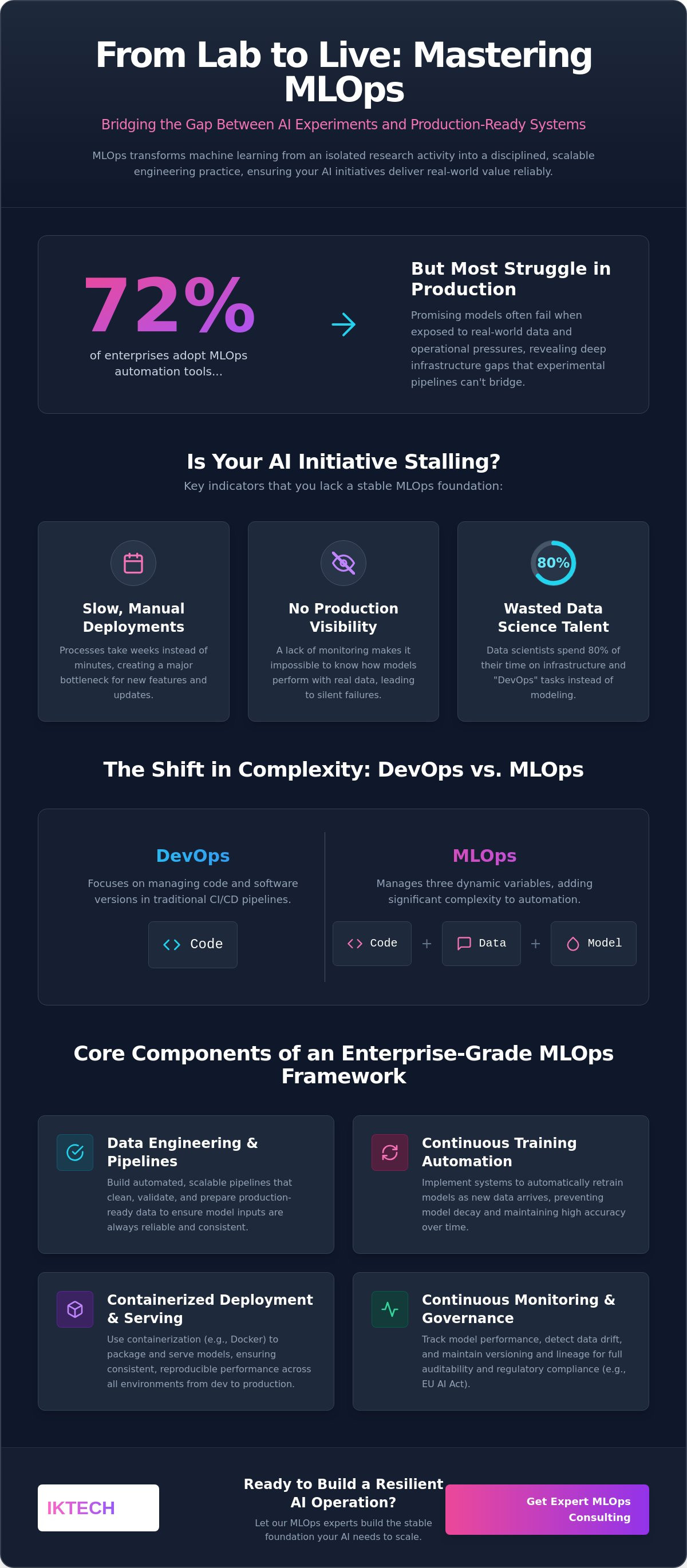
While 72% of enterprises are now adopting automation tools to manage their machine learning lifecycles, most organizations still struggle to move models out of the experimental phase and into a reliable production environment. The transition from a notebook to a stable system often reveals deep-seated infrastructure gaps that fragile pipelines cannot bridge. Specialized mlops consulting services address these technical bottlenecks by treating machine learning as a disciplined software engineering challenge rather than a series of isolated experiments. This approach ensures that your AI initiatives don't just work in a controlled lab setting but remain resilient when exposed to real-world data and operational pressures.
You likely understand the frustration of watching a promising model fail because of data drift or a lack of coordination between your data scientists and DevOps teams. It's a common hurdle that prevents AI from delivering its full strategic value. This article explores how professional consulting provides the repeatable framework you need to stabilize your AI operations and accelerate your time-to-market for new features. We'll examine the core components of engineering excellence, from automated monitoring to the integration of the latest tools like MLflow 3.13.0, to help you build a predictable and high-performing ML infrastructure.
Key Takeaways
- Learn how to bridge the gap between experimental data science and stable production environments by integrating DevOps discipline into the machine learning lifecycle.
- Understand the critical role of automated data pipelines and continuous training in preventing model decay and mitigating technical debt within enterprise systems.
- Discover how professional mlops consulting services utilize containerization and infrastructure modernization to build a scalable foundation for resilient AI operations.
- Explore a pragmatic implementation roadmap that begins with a maturity assessment and leverages strategic outsourcing to overcome specialized engineering recruitment hurdles.
- Identify the core components of an engineering-first framework that ensures predictable performance and reduces time-to-market for machine learning features.
What are MLOps Consulting Services and Why are They Critical in 2026?
At its core, MLOps represents the critical intersection of machine learning, DevOps, and data engineering. While many organizations successfully build predictive models in isolated environments, they often fail to maintain them when they hit production. This gap is where mlops consulting services provide the most value by transforming experimental scripts into reliable enterprise assets. In 2026, the industry has shifted beyond basic automation toward autonomous, self-healing pipelines that can detect failures and retrain models without manual intervention. This evolution is necessary because machine learning systems suffer from a unique form of technical debt. If you don't have a robust operational framework, your models will naturally decay as real-world data evolves, leading to inaccurate predictions and wasted compute resources.
The primary role of an MLOps consultant is to bridge the gap between research and operations. They don't just write code; they design the architectures that allow AI to survive in a dynamic business environment. By 2026, approximately 72% of enterprises have adopted some form of MLOps automation, yet many still struggle with the complexity of scaling these systems. A consultant's job is to ensure that your infrastructure can handle the massive throughput of modern data streams while maintaining the strict governance and audit trails required by current regulations like the EU AI Act. By implementing standardized frameworks, consultants reduce the technical debt that accumulates when models are deployed without proper lineage tracking or version control.
The Fundamental Difference Between DevOps and MLOps
Standard DevOps practices focus on managing code and software versions, but machine learning introduces two additional variables: data and the model itself. A system that works perfectly today might fail tomorrow because the underlying data distribution has changed, a phenomenon known as model drift. Traditional CI/CD pipelines aren't equipped to handle this because they don't monitor for statistical deviations or trigger retraining based on performance drops. MLOps is the engineering discipline that ensures ML models are reproducible and scalable.
Signs Your Organization Needs Professional MLOps Consulting
Identifying the need for external expertise often starts with recognizing internal bottlenecks. Professional mlops consulting services are typically required when you encounter the following challenges to your operational stability:
- Manual deployment processes that take weeks instead of minutes.
- Lack of visibility into how models are performing with real-world production data.
- Data scientists spending 80% of their time on infrastructure rather than modeling.
These issues indicate that your AI initiatives lack the necessary engineering foundation to scale effectively. Without a repeatable framework for deployment and monitoring, your organization remains trapped in a cycle of manual fixes that prevent you from achieving predictable and stable AI operations.
The Core Components of an Enterprise-Grade MLOps Framework
Many businesses treat AI as a research project, but enterprise-grade systems require a foundation built on operational stability. According to MLOps: What You Need To Know, the challenge isn't just creating a model; it's the complex process of putting it into production and keeping it there. Reliable mlops consulting services focus on four primary pillars to ensure long-term success:
- Data Engineering: Building automated pipelines that ensure data is cleaned, validated, and ready for production at scale.
- Model Training Automation: Setting up systems that can retrain models as new data arrives to maintain accuracy over time.
- Deployment & Serving: Using containerization to ensure that models perform consistently across different cloud environments.
- Monitoring & Observability: Implementing real-time feedback loops to detect performance degradation or data drift immediately.
These components work together to create a resilient ecosystem. Without this structure, models quickly become liabilities rather than assets. If you're looking to strengthen your operational foundation, exploring infrastructure modernization can provide the security and scalability required for these advanced frameworks.
Automated CI/CD/CT Pipelines for Machine Learning
Traditional software delivery relies on CI/CD to manage code, but machine learning requires an additional layer: Continuous Training (CT). This is the missing link. It allows a system to automatically retrain and redeploy models based on fresh data triggers. Effective pipelines must version not just the application code, but also the datasets and the specific model weights used in each iteration. This granular level of control ensures that every deployment is reproducible; teams can roll back to a previous stable state if a new model underperforms in the wild.
Model Governance and Security Compliance
As we move through 2026, regulatory scrutiny has intensified. Transparency and auditability are now non-negotiable for high-risk AI systems. Professional mlops consulting services prioritize model governance by implementing detailed audit trails and "Human-in-the-loop" checkpoints. These manual interventions ensure that critical decisions are reviewed by experts before they affect end users. Security is equally vital. Consultants work to protect the entire ML supply chain from adversarial attacks that could compromise model integrity. This disciplined approach ensures that your AI operations remain compliant with global standards while maintaining peak performance.
Engineering-First vs. AI-First: Why Infrastructure Modernization is the Secret
Successful enterprise AI is rarely a result of superior algorithms alone. It's the result of a disciplined engineering foundation that can support those algorithms at scale. While many firms focus on the model itself, mlops consulting services emphasize that infrastructure modernization is the true secret to long-term stability. We view Cloud DevOps Consulting as a mandatory prerequisite rather than a secondary consideration. As detailed in the Google Cloud resource on MLOps: Continuous delivery and automation pipelines in machine learning, automation is the only mechanism that allows for the reliable delivery of ML components. Implementing Infrastructure as Code (IaC) ensures that these environments are reproducible, allowing teams to spin up identical training or inference clusters in minutes across any environment.
Modernizing your infrastructure isn't just about moving to the cloud; it's about adopting a mindset where every part of the ML lifecycle is treated with the same rigor as traditional software development. This engineering-first approach eliminates the silos between data scientists and operations teams. By establishing a robust foundation first, you ensure that your AI initiatives are built to last rather than being fragile experiments that break the moment they encounter production-scale traffic.
Containerization: The Backbone of Portable ML Models
Containers package code, libraries, and system dependencies into a single, immutable unit. This solves the persistent "it works on my machine" issue that often plagues data science teams when they attempt to hand off models to engineers. When you use Kubernetes for orchestration, you can scale ML workloads dynamically based on real-time demand. This ensures you're only paying for the compute resources you actually use during intensive training phases. Standardized environments reduce the friction between development and production, leading to immediate efficiency gains and more predictable model behavior.
Modernizing Legacy Systems for AI Integration
Legacy monolithic systems are often the biggest roadblock to AI adoption. These systems aren't designed to handle the high-velocity data streams or the elastic compute requirements of modern ML pipelines. Trying to "bolt on" AI to an outdated monolith usually leads to performance bottlenecks and high maintenance costs. Decoupling data sources from these legacy systems is a critical first step. It allows you to feed clean, structured data into your models without disrupting core business operations. For enterprises managing sensitive data, a pragmatic hybrid cloud strategy often provides the best balance between on-premise security and the scalability of the cloud. This modernization process ensures that your mlops consulting services deliver a system that is both flexible and resilient.
Implementing MLOps: A Pragmatic Roadmap for 2026
Transitioning from experimental AI to a production-grade environment requires a structured, linear progression that aligns technical capabilities with specific business objectives. Effective mlops consulting services provide the architectural framework necessary to navigate this transition without disrupting existing workflows. This roadmap ensures that each stage of development builds upon a stable foundation, moving from initial assessment to long-term optimization. By following a methodical path, organizations can avoid the "Technical Debt" trap discussed earlier and ensure their AI investments yield predictable results.
- Step 1: Maturity Assessment. We audit your current data quality, infrastructure readiness, and team skill sets to identify specific operational gaps.
- Step 2: Foundation Building. This phase focuses on establishing the cloud environment and container orchestration layers required for scalability.
- Step 3: Pipeline Pilot. We automate a single, high-impact ML workflow as a proof of concept to validate the technical architecture.
- Step 4: Scaling and Integration. Once the pilot is successful, we expand the framework across the organization to standardize all AI delivery.
- Step 5: Continuous Optimization. We refine monitoring systems and feedback loops to ensure models remain performant as data volumes grow.
Success in these stages depends on treating AI as a core component of your digital infrastructure. If you're ready to move beyond the experimental phase, our experts can assist with professional system implementation to ensure your environment is built for long-term stability.
Phase 1: Assessing MLOps Maturity
Maturity isn't a binary state; it ranges from manual, script-driven workflows to fully automated, self-correcting systems. A consultant's primary task during this phase is to pinpoint the exact bottleneck in your production lifecycle, whether it's slow data labeling or a lack of model versioning. Industry reports frequently highlight that a vast majority of ML projects fail to reach production because organizations skip this critical audit. By understanding your starting point, you avoid the common pitfall of over-engineering solutions that don't address your actual operational constraints.
Phase 2: Selecting the Right MLOps Tech Stack
Choosing between managed services like AWS SageMaker and Google Vertex AI or open-source orchestrators like Kubeflow and MLflow is a strategic decision. Managed services offer speed and ease of use, while open-source tools provide greater flexibility and help avoid vendor lock-in. Your architecture should remain modular, allowing you to swap components as the ecosystem evolves. It's essential to select tools that integrate seamlessly with your existing DevOps toolchain to ensure a unified workflow. This alignment reduces the learning curve for your engineering teams and ensures that your mlops consulting services deliver a cohesive, manageable stack.
Strategic MLOps Outsourcing: Scalability Through Expert Engineering
Hiring in-house MLOps talent remains one of the most significant recruitment hurdles in 2026. The role requires a rare combination of machine learning expertise and seasoned DevOps discipline, a skillset that is both scarce and expensive to maintain. Instead of spending months searching for individual hires, many organizations use mlops consulting services to gain immediate access to high-level architecture and implementation expertise. This strategic outsourcing allows you to modernize your infrastructure and establish stable operations while your core data science team remains focused on business-specific modeling and research. By partnering with external specialists, you bypass the learning curve and move directly to a production-ready state.
IK Tech Solutions acts as a disciplined, operational partner, providing the technical depth required for complex system implementation and infrastructure modernization. Our approach focuses on delivering measurable results rather than theoretical advice. We take full responsibility for the systems we manage, ensuring that your AI infrastructure is not only scalable but also resilient enough to handle the pressures of enterprise-grade workloads. This allows your leadership to focus on strategic growth while we handle the intricate engineering required to keep your models performant and secure.
Bridging the Talent Gap with Dedicated Engineering Units
Dedicated engineering units integrate seamlessly with your existing data science and IT departments to create a unified workflow. These teams bring a sense of order and transparency to often chaotic ML environments by implementing standardized protocols for deployment, testing, and monitoring. A key advantage of this engagement is the deliberate transfer of knowledge. Throughout the project, consultants work alongside your internal staff, ensuring they understand the underlying architecture and operational requirements. This collaborative approach leaves your team better equipped to manage the infrastructure long after the initial implementation is complete.
The ROI of Professional MLOps Implementation
The return on investment for professional MLOps is measurable across several key performance indicators. By optimizing inference processes and resource allocation, organizations can significantly reduce server costs and improve the overall efficiency of their cloud environments. Automated pipelines lead to faster deployment cycles, allowing you to iterate on ML features in minutes rather than weeks. This speed is matched by higher model accuracy, as continuous training ensures your systems adapt to new data in real time.
Robust MLOps practices also prevent "silent failures," which occur when models continue to run but provide degraded or inaccurate outputs. These failures can cost enterprises millions in lost revenue or operational errors if not detected immediately. Professional implementation ensures that your monitoring systems identify these deviations before they impact your bottom line.
Ready to stabilize your AI infrastructure? Contact IK Tech Solutions for a pragmatic MLOps assessment.
Securing Your AI Future with Operational Excellence
Building a resilient AI ecosystem requires moving beyond the lab and into a disciplined, engineering-first environment. We've explored how infrastructure modernization, automated pipelines, and containerization serve as the non-negotiable standards for operational stability in 2026. Engaging with professional mlops consulting services allows your organization to bridge the specialized talent gap while maintaining a primary focus on core business objectives. This structured approach ensures that your machine learning initiatives aren't just innovative experiments but stable enterprise assets that deliver measurable results.
IK Tech Solutions brings a seasoned perspective to high-impact technology architecture and software engineering, ensuring your cloud infrastructure is ready for the demands of modern machine learning. Our proven track record in containerization and strategic technical outsourcing provides the steady hand needed to scale your engineering capabilities effectively and transparently. It's time to replace fragile pipelines with a predictable framework built for long-term success.
Partner with IK Tech Solutions for Enterprise MLOps and Infrastructure Modernization. Transitioning to a production-grade AI infrastructure is a complex undertaking, but with the right architectural foundation, your models will deliver predictable and lasting value.
Frequently Asked Questions
What is the primary goal of MLOps consulting services?
The primary goal of mlops consulting services is to transform experimental machine learning code into stable, production-ready enterprise assets. Consultants focus on creating a repeatable framework for deployment, monitoring, and maintenance. This ensures that AI models remain reliable and scalable when exposed to real-world data, ultimately reducing the time-to-market for new features and stabilizing operational costs through disciplined engineering practices.
How does MLOps differ from traditional DevOps?
While traditional DevOps focuses on managing code versions and application lifecycles, MLOps must simultaneously manage code, datasets, and model weights. Machine learning introduces unique challenges like model drift and data decay that standard CI/CD pipelines cannot address. MLOps extends DevOps principles by adding continuous training and monitoring for statistical deviations in data, ensuring the entire system remains accurate as environments evolve.
Can MLOps be implemented on-premises or is it cloud-only?
MLOps can be implemented in both on-premises and cloud environments, although cloud-based solutions are projected to hold a 51.0% market share in 2026. Many enterprises in regulated industries choose hybrid or on-premises deployments to maintain strict control over sensitive data. Modern containerization tools like Kubernetes and Docker allow for a consistent MLOps framework regardless of the underlying hardware or hosting provider.
How long does it typically take to see ROI from MLOps consulting?
Most organizations begin to see a return on investment within three to six months after the initial implementation of a pilot pipeline. This ROI manifests through reduced server costs from optimized inference, faster deployment cycles, and the prevention of revenue loss caused by silent model failures. Long-term gains include significantly lower technical debt and a more scalable foundation for future AI initiatives.
What are the most common tools used in a modern MLOps tech stack?
A modern MLOps tech stack typically includes orchestrators like Kubeflow or MLflow 3.13.0 for experiment tracking and model management. Managed services such as AWS SageMaker or Google Vertex AI are popular choices for end-to-end lifecycle control. For infrastructure, Kubernetes and Docker are the non-negotiable standards for containerization, while Terraform often handles Infrastructure as Code to ensure environment reproducibility across the organization.
Is MLOps necessary for small-scale AI projects?
Even small-scale AI projects require basic MLOps principles if they are intended for production use. Without automated monitoring and version control, even a single model can become a maintenance burden as data changes. Implementing a lightweight MLOps framework early prevents technical debt from accumulating and ensures that the project can scale without requiring a complete and costly architectural overhaul later in its lifecycle.
How does MLOps handle data privacy and security compliance?
Professional mlops consulting services integrate security and compliance directly into the pipeline through lineage tracking and automated audit trails. These systems ensure that every model prediction can be traced back to the specific data and code used during training. This level of transparency is critical for meeting regulatory requirements like the EU AI Act and protecting the machine learning supply chain from adversarial attacks.
What happens if we don’t implement MLOps for our production models?
Failing to implement MLOps leads to a technical debt trap where models gradually decay and lose accuracy as real-world data evolves. This results in fragile pipelines that break with new data inputs and require constant manual intervention from your data science team. Over time, the lack of visibility into model performance can lead to significant financial losses and the eventual failure of AI initiatives.